
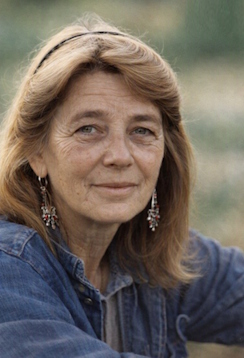
Suzanne Hubbell (née Gilbert)
Born: 28th January 1935 Kalamazoo, Michigan
Died: 13th October 2018 Bar Harbor, Maine (aged 83)
Education: Western Normal High School Kalamazoo. Swarthmore College. B.A. in journalism University of Southern California 1956. MSc in library science Drexel University Pennsylvania 1965.
Nationality: American
Sue Hubbell was a bookseller, librarian, student counsellor, anti-war activist, author, and commercial beekeeper. She became widely known through her articles in magazines, beginning with the American Bee Journal, and later through her bestselling books, including A Country Year: Living the Questions (1986) and A Book of Bees: And How to Keep Them (1988).
Sue Hubbell grew up in Kalamazoo, Michigan, where she attended Western Normal High School; it was there that she met Paul Hubbell, who would later become her husband. After high school she enrolled at the University of Southern California to study journalism, and during this time she became pregnant and married Paul in 1955. Despite the challenges of raising an infant son, Brian, she completed her degree in 1956.
In 1960, she became manager of a bookshop called The Book Shelf in Moorestown, New Jersey, and three years later she took a position as acquisitions librarian at Trenton State College. After spending a year as a school librarian in Peace Dale, Rhode Island, she joined Brown University, where she worked as a serials librarian from 1968 until 1972.
The Vietnam War increasingly dominated American society. The conflict expanded throughout the 1960s and early 1970s, bringing growing public opposition. To sustain the war effort, the United States government relied heavily on military conscription, commonly known as "the Draft", whereby millions of young Americans were called into military service, and anti-war demonstrations became common across the country.
In April 1970, President Richard Nixon announced the expansion of military operations into Cambodia, which sparked widespread protests on university campuses. At Kent State University in Ohio, National Guardsmen fired on student demonstrators, killing four and wounding nine others. Eleven days later, police opened fire on protesters at Jackson State University in Mississippi, killing two students and injuring twelve more.
These events deeply affected Sue Hubbell. By this time, she was also working as a student counsellor and had become an outspoken opponent of the war. She and her husband felt increasingly alienated from government policies and objected to paying taxes that supported a conflict they strongly opposed. Determined to find a different way of life, the couple left their jobs and set off across America in a Volkswagen camper van with their son, and for a year they travelled in search of a place to begin again.
Their search ended in the Ozark Mountains of Missouri, where they purchased ninety acres of land and embraced a back-to-the-land lifestyle. During their first year they built a home and barns and planted 1,700 pine trees. Although the surrounding area was cattle country, neither Sue nor Paul had any experience with livestock. Recalling those early days, Sue later remembered, "When the money started running out, Paul said, 'Well, we might as well do bees. We don't know anything about cows.'"
They began with ten beehives. The operation gradually expanded to forty hives, then one hundred, and eventually around three hundred colonies. To grow the business, they established small apiaries of ten or twelve hives on neighbouring farms, paying the farmers a gallon of honey each year as rent.
Beekeeping became both Sue's livelihood and lifelong passion. In A Book of Bees: And How to Keep Them, she wrote, "For a long, long time, for nearly forty years, I never had any bees. I can't think why. Everyone should have two or three hives of bees. Bees are easier to keep than a dog or cat. They are more interesting than gerbils. They can be kept anywhere." She famously described beekeeping as, "Farming for intellectuals."
Despite her love of bees, commercial honey production was rarely lucrative. Sue described the business as, "A shaky, marginal sort of affair that never quite leaves me free of money worries, but which allows me to live in these hills that I love."
The physical demands of commercial beekeeping, combined with long periods spent travelling to sell honey, sleeping in the truck to save paying for accommodation while away, placed strains on her personal life. Looking back, she attributed the breakdown of her thirty-year marriage partly to the relentless hard work and frequent absences required by the business.
Sue found herself alone, running the commercial honey business singlehandedly. Writing eventually provided both a creative outlet and an additional source of income. As Sue explained, "I come from a family of writers, and it's our habit that when you need some money, you write something."
Years later as she entered her sixties, Sue recognised that commercial beekeeping was becoming increasingly difficult, "I'm 60, and it's hard work. I knew I wasn't going to be able to do that all my life." Yet her affection for bees never faded, "I knew I would never be happy without bees in my life, but I didn't need 300 hives to be happy. And so I have great happiness now with 10."
When she eventually had to leave her Ozark property, she made an unusual decision. Wanting the landscape to return to its natural state, she demolished her home and barns and donated the land to the state of Missouri for conservation.
In her later years, Sue began experiencing memory loss and increasing confusion. Although she remained lucid for much of the time, dementia was gradually taking hold. In August 2018, she became lost while walking alone and had to be located by a search team. She subsequently moved to Bar Harbor, Maine, to be closer to her son and his family.
Knowing that her dementia would continue to worsen, Hubbell made a deeply personal decision about the end of her life. According to her son Brian, "Sue decided that she strongly wished not to descend into dementia under indefinite institutional care." Brian later recalled, "She informed her friends and doctor that she intended to stop eating and drinking. She died 34 days later."
Sue Hubbell left behind a rich legacy as a writer, naturalist, beekeeper and advocate for simple living. "I like pulling on a baggy bee suit, forgetting myself and getting as close to the bees' lives as they will let me, in the process remembering that there is more to life than the merely human."